

Spirit OF 1968 Nigeria’s Civil War pays a visit to sudan but this time more Furious.
Why is this war scenario often common in Africa? In the same country, in the same military, we see division erupt, before you successfully bat an eyelid, a catastrophic war has erupted, the war is often deadlier than the war witnessed between two different countries.
What is wrong with Africa? Why can’t they use diplomacy to address their dispute. This whole democracy propaganda, for Africa it is better to sing it than practice it.
Two years of civil war have decimated Sudan. Civilians are subject to frequent attacks and human rights violations while the country’s health care system has collapsed and life-threatening famine sets in. Attacks on humanitarian aid workers have made it difficult to deliver lifesaving aid to some of the most fragile and vulnerable communities in the world.
War continues to rage in Sudan
War broke out between the two faction of Sudan’s Military, Sudanese Armed Forces (SAF) and the Rapid Support Forces (RSF), on April 15, 2023, this plunged the country into chaos. Civilians bear the brunt of the conflict; sexual violence is widespread, fighters on both sides regularly target civilians and infrastructure, and child soldier recruitment is common. Human rights groups have accused fighters in Darfur of ethnic cleansing.
Tens of thousands have been killed, with indiscriminate attacks on civilians being reported.
Rather than advancing diplomacy, outside powers are fueling the conflict by funneling weapons to their allies. SAF and RSF leaders appear to believe that continued fighting best serves their interests, leaving Sudan on a trajectory toward catastrophic humanitarian collapse.
“Enough is enough. More words can no longer capture the catastrophic toll of this devastating conflict on over 30 million lives; the failure of diplomatic actors to respond effectively has allowed Sudan’s crisis to worsen beyond measure,” says IRC East Africa Advocacy Coordinator, Anne Marie Schryer.
Sudan is the world’s largest and fastest displacement crisis
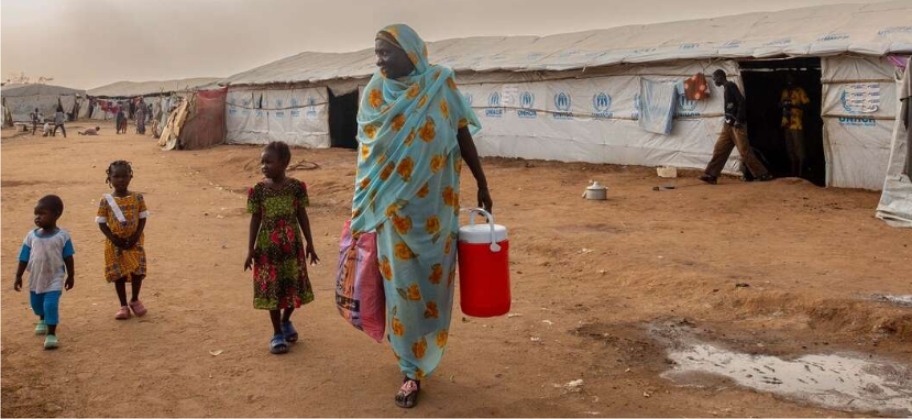
The war in Sudan has created extreme levels of displacement, both internally and across Sudan’s borders. More than 12 million people have been displaced since April 2023, nearly 4 million people—mostly women and children—who have fled to neighboring countries.
Resurging outbreak of cholera.
Compounding the crisis, heavy rains and flooding from June 2024 to September 2024 have affected nearly 600,000 people, displacing over 172,500 individuals and causing severe destruction of homes and infrastructure, and contributing to a resurging outbreak of cholera. The worst-hit areas, including Red Sea and North Darfur, face heightened risks of famine, further exacerbating the challenges for residents already grappling with conflict and instability.
Life is safer in the crowded camps, but they are stalked by disease – most deadly of all: cholera, caused by polluted water. The outbreak is triggered by the destruction of water infrastructure and lack of food and medical care, and made worse by flooding due to the rainy season.
It is caused by polluted water and has killed hundreds in Sudan, triggered by the destruction of water infrastructure and lack of food and medical care, and made worse by flooding due to the rainy season
While neighboring countries—like Chad and South Sudan—have welcomed Sudanese refugees fleeing conflict, they do not have the resources to meet the urgent humanitarian needs of those arriving across the border without international support.
Women and children face heightened risks
The ongoing crisis in Sudan is taking a devastating toll on women and girls. The collapse of critical healthcare services has put new mothers at risk of losing their lives in the months ahead as it has become nearly impossible to access essential reproductive care.
Gender-based violence is escalating. Reports of intimate partner violence, sexual exploitation, abuse and trafficking are widespread, while survivors struggle to access support. Economic hardship has stripped countless women of their livelihoods, forcing many into desperate and exploitative situations, and increasing their vulnerability.
In Darfur, the crisis has deepened amidst ongoing fighting that targets civilians, continued displacement and the declaration of famine. Alarming reports of sexual violence underscore the immense suffering endured by those in dire conditions, revealing the exceptional vulnerability of women and children.
Urgent action is needed to address these atrocities and provide support to those affected.
FOOD SCARCITY
Food is so scarce in el-Fasher that prices have soared to the point where money that used to cover a week’s worth of meals can now buy only one. International aid organisations have condemned the “calculated use of starvation as a weapon of war”.
The UN has amplified its appeal for a humanitarian pause to allow food convoys into the city, with its Sudan envoy Sheldon Yett once more demanding this week that the warring sides observe their obligations under international law.
The army has given clearance for the trucks to proceed but the UN is still waiting for official word from the paramilitary group.
RSF advisers have said they believed the truce would be used to facilitate the delivery of food and ammunition to the army’s “besieged militias” inside el-Fasher.
They have also claimed the paramilitary group and its allies were setting up “safe routes” for civilians to leave the city.
HOSPITALS NOT COPING
Hospitals cannot cope. Few are still operating. They have been damaged by shelling and are short of medical supplies to help both the starving, and those injured in the continual bombardment.
“We have many malnourished children admitted in hospital but unfortunately there is no single sachet of [therapeutic food],” says Dr Ibrahim Abdullah Khater, a paediatrician at the Al Saudi Hospital, noting that the five severely malnourished children currently in the ward also have medical complications.
“They are just waiting for their death,” he says. When hunger crises hit, those who usually die first are the most vulnerable, the least healthy or those suffering from pre-existing conditions.
“The situation, it is so miserable, it is so catastrophic,” the doctor tells us in a voice message.
“The children of el-Fasher are dying on a daily basis due to lack of food, lack of medicine. Unfortunately, the international community is just watching.”
International non-governmental organisations working in Sudan issued an urgent statement this week declaring that “sustained attacks, obstruction of aid and targeting of critical infrastructure demonstrate a deliberate strategy to break the civilian population through hunger, fear, and exhaustion”.
They said that “anecdotal reports of recent food hoarding for military use add to the suffering of civilians”.
“There is no safe passage out of the city, with roads blocked and those attempting to flee facing attacks, taxation at checkpoints, community-based discrimination and death,” the organisations said.
Hundreds of thousands of people did flee in recent months, many from the Zamzam displaced persons camp at the edge of el-Fasher, seized by the RSF in April.
They arrive in Tawila, a town 60km (37 miles) west of the city, weak and dehydrated, with accounts of violence and extortion along the road from RSF-allied groups.
#Sudan #prayforsudan #stopthewarinsudan #helpsudan #ceaseweaponsupply #stopfuelingwarinafrica #stopafricanwars
