

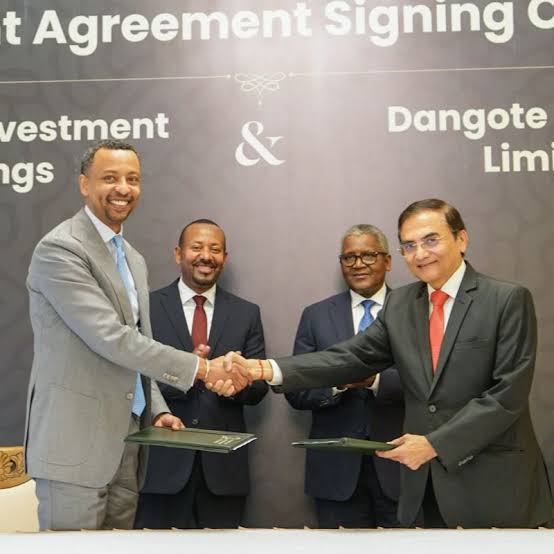
Ethiopia has entered a landmark partnership with Nigeria’s Dangote Group, signing a $2.5 billion agreement to build a fertiliser plant in the southeastern town of Gode.
Prime Minister Abiy Ahmed, who formally announced the deal, said the facility will have the capacity to produce three million metric tonnes of fertiliser annually. Once operational, the plant is expected to make Ethiopia a major supplier for its domestic farmers while positioning the country as a regional hub for agricultural inputs.
This development is part of a broader effort to end Africa’s dependency on imported fertilisers. The continent, despite holding nearly a quarter of the world’s arable land, consumes only a fraction of global fertiliser production. High costs, poor access, and fragile supply chains have long undermined food security across Africa. Ethiopia’s gamble is to shift from importer to producer, using its natural gas reserves in the Ogaden Basin as feedstock to power fertiliser production. For Ethiopian farmers, this could mean reduced import bills, more stable supplies, and greater protection from the volatility of global energy and commodity market.
Aliko Dangote, Africa’s richest man, framed the partnership as more than a business venture. At the signing ceremony, he described it as a shared vision to industrialise Africa and secure the continent’s food future. The deal, signed between Ethiopian Investment Holdings and Dangote Group, gives Ethiopia a 40 percent stake in the project, while Dangote retains 60 percent. This arrangement allows the government to safeguard national interests while relying on Dangote’s expertise, capital, and global networks. Analysts see this model of joint ownership as a potential blueprint for other African nations trying to solve systemic challenges that governments or businesses cannot tackle alone.
The implications extend far beyond Ethiopia’s borders. Africa’s population is projected to rise from today’s 1.4 billion to nearly two billion by 2050, which will drive up demand for food and fertiliser alike. At present, food imports into Africa exceed $40 billion annually, a figure that risks climbing higher if local production continues to lag behind population growth. The new Ethiopian plant could ease that pressure, reducing reliance on imports while also supplying neighbouring markets in Kenya, Djibouti, Somalia, and Sudan. For Abiy Ahmed’s administration, the project aligns seamlessly with the Homegrown Economic Reform Agenda, which prioritises industrialisation, agricultural transformation, and energy development.
