

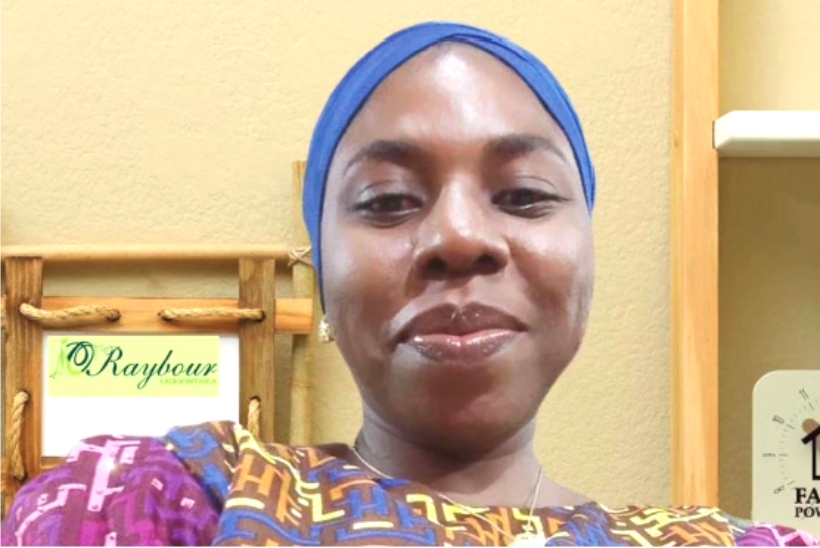
In Lagos’ bustling markets, where fabrics spill from crowded stalls in a riot of colours, most people see nothing but commerce. However, Sidikat Folami, the founder of Mateen Lander, sees a mounting crisis of textile waste and an untapped well of possibility. What began as a childhood fascination has since become a mission to change how Nigerians think about waste, one thread at a time.
Born in Kaduna in 1983 to parents from Ijebu-Mushin in Ogun state, Folami grew up as a deep thinker and an observant child with a natural inclination to solve problems.
I’ve always been a conscious person. Growing up, my mum and other people would jokingly tag me as a witch because I think and act differently. People would usually describe me as more mature for my age, and it made me angry,”
Despite her early interest in fashion, Folami initially dreamt of becoming a pharmacist or clinical psychologist. But life had other plans. After surviving multiple crises in northern Nigeria, her family relocated to Ibadan, Oyo State. She later pursued a diploma in library and information science at Olabisi Onabanjo University, followed by a graduate diploma in data processing management.

Yet, the pull of garment making remained strong. By 2008, she made a decisive move that she would not seek employment but instead create opportunities for others. She trained in tailoring, honed her skills, and in February 2009, launched O’Raybour FashionFrica. She also relocated to Lagos the same year.
“My journey into garment making started as a result of my consciousness as a child. We had a sewing machine at home because my dad doesn’t like torn clothes, and so my mom does all our alterations,” she said.
“I took one of my mom’s old wrappers and made it into something else that my younger sister could wear. From then on until I got into the university, I continued mending clothes. I was between the ages of 13 and 16.”
Her early exposure to sewing came from watching her mother mend torn clothes at home. But it wasn’t until a trip to Lagos in the mid-1990s that her curiosity deepened. Watching her cousin take tailoring classes, she picked up a needle and thread and stitched together a dress from her mother’s old wrapper, which was an act of upcycling before she even knew what the term meant..
SHIFT FROM FASHION TO TEXTILE WASTE MANAGEMENT
For years, Folami ran a successful business catering to affluent clients at home and abroad. But the growing piles of textile waste her operations were generating became a problem that kept nagging her. Every garment produced led to off-cuts (excess fabric from cutting patterns), and even donated scraps often ended up in landfills.
The global textile industry is one of the most environmentally damaging sectors, accounting for around ten percent of emissions and twenty percent of wastewater production.
About 92 million tonnes of textile waste is produced every year, and nearly five percent of all waste in landfills comprises textile materials, while about 35 percent of primary microplastic pollution in the oceans comes from the fashion industry.

In 2024, the Lagos Waste Management Authority (LAWMA) revealed that 85 percent of the state’s textile waste is disposed of in landfills. Similarly, the office of climate change and circular economy disclosed.
that textiles make up two percent of the municipal waste generated in Lagos, translating to about 2,000 tonnes of textile waste produced each day, with the majority ultimately ending up in landfills.
“In the Nigerian fashion industry, everybody is always making something new tomorrow and the day after that. We are always generating off-cuts, even as a bulk garment maker supplying to companies in the UK and US,” Folami said.
“I started thinking, ‘What can be done with all this waste?’ I didn’t fully understand sustainability at the time or how it connected to my business. I just knew there had to be a better way. And in 2019, my interest grew stronger.”
Inspired by the transformation of plastic waste into usable products, Folami wondered if textiles could undergo a similar process and began exploring the potential of textile recycling. It wasn’t until 2022, after attending several sustainability and recycling events, that her vision crystallised.
“I met Olusola Idowu of Fashion Revolution, and she encouraged me to shift my focus from plastic to textile. She introduced me to their programmes, and this helped me to think differently about textile waste management,” she said.
In January 2023, she co-launched FabriThread — a project with eight women dedicated to breaking down textile waste into raw materials for industrial use. In 2024, she officially launched Mateen Lander Limited.
According to the European Union (EU), less than one percent of all textiles worldwide are recycled into new products. The EU added that technologies that would enable clothes to be recycled into fibers are only now starting to emerge.
While upcycling (fabric waste turned into new products) is beginning to gain traction in Nigeria, textile recycling remains largely untapped. Through Mateen Lander, Folami said she aims to change that.
Her company specialises in fiberising textile waste, that is, breaking it down into raw fibers that can be used in industries such as construction, automotive manufacturing, and eco-friendly product development. Her team sources waste from households, garment manufacturers, and textile factories, with collection centers in Ajah, Yaba, and Badagry areas of Lagos.
Folami said Mateen Lander has collected over 35 tonnes of textile waste from landfills since August 2024, diverting them from the environment and repurposing them for industrial use.
But the journey is not without challenges. “Funding is a major issue. Textile recycling is very expensive,” she said. The market also faces a knowledge gap, with many potential off-takers unaware of the potential of textile fiber.
“We are looking at getting access to funding and incentives that can relieve some of the burden. The equipment and logistics are expensive. But our focus is to ensure that what we’re doing is sustainable for the long term. We’ve explored the market, and we understand that this journey may take a while,” she added.
Despite these hurdles, Folami has secured key partnerships. Mateen Lander is now the official material recovery partner for textile waste in Lagos through the office of the special adviser on climate change and circular economy (OCCE).
“Our major partnership so far is with Titilayo Oshodi, special adviser to the Lagos governor on climate change and circular economy. Our partnership with them has been instrumental and has helped us in advocacy and visibility in Lagos state,” Folami said.
The Global Cleantech Innovation Programme by the United Nations Industrial Development Organization (UNIDO) has also provided valuable training, while BASF West Africa has helped enhance the quality of collected textile fibers.
Folami understands that tackling Nigeria’s textile waste problem requires large-scale solutions, not just small-scale interventions.
She said one of the primary objectives is to secure industrial offtakers — companies willing to purchase recycled textile waste in significant quantities. While small buyers exist, they are not enough to drive a large-scale impact. She said her organisation is actively working to connect with industries where recycled fabrics can be repurposed.
Beyond securing buyers, Folami said she is determined to build an ecosystem where multiple players contribute to a circular economy. She envisions a thriving industry where different small businesses, entrepreneurs, and innovators play a role in textile waste recycling because “Mateen Lander can’t do it alone.”
EMPOWERING WOMEN THROUGH WASTE-TO-WEALTH INITIATIVES
Beyond sustainability and environmental impact, Folami is deeply committed to women’s empowerment. Her waste-to-wealth programmes train women in waste management, equipping them with skills to generate income. Through partnerships with Lagos Women Run and the OCCE, her organisation has trained and supported women with startup capital to explore sustainable fashion and textile recycling.
“Women are strong, but we also need more support. A lot of women are affected by gender stereotypes, and part of our initiative is to support them and empower them with skills to earn a living,” she said.
“I know how my vocational training and entrepreneurship have helped me to overcome a lot of life’s challenges. So, it’s important to me that our programmes focus on closing the knowledge gap in textile waste management and encourage women’s participation.”
Folami says that the accolades she has earned, including the UNIDO-GCIP Global Most Gender-Inclusive Business Award (2024) and the ELOY Sustainability and Environment Award (2024), serve as both validation and motivation. Achievements are recognized on merit rather than gender.
Vision for Equal Access to Finance and Capital
Looking ahead, my vision is for a future where women entrepreneurs have equitable access to finance and capital based solely on their merit and potential. This requires systemic changes in how financing opportunities are allocated, fostering an environment where women can thrive through their innovation and hard work without bias or discrimination, and creating a support system for female founders to thrive.
Envisioning the Future Role of Women in Climate and Energy Tech
I see women playing a pivotal role in shaping the future of climate and energy tech. As more women enter and excel in these fields, diverse perspectives and innovative solutions will drive transformative change. Empowering women with equal opportunities in leadership, entrepreneurship, and investment will accelerate progress toward sustainable development goals.
Advice to Aspiring Women Entrepreneurs
To women aspiring to start their businesses in the sustainable energy and climate sectors, my advice is to stay resilient and persistent. Believe in the value of your ideas and innovations and seek mentorship and support from networks that champion diversity andchallenges as opportunities for growth and continue advocating for equal recognition of women’s contributions in these critical sectors.
As the world observes the 2025 International Day of Zero Waste on March 30, with a focus on ‘zero waste in fashion and textiles’, Folami’s work couldn’t be more relevant.
In Nigeria, where textile waste often ends up in landfills or is burned, she invites us to treat it as valuable and that discarded fabrics don’t have to be the end of the story.
There is a strong demand for the advancement of recycling technologies as they broadly apply to specific fibres or fibre blends. Various technologies are developed for recycling textiles based on mechanical, chemical, thermo-mechanical, thermo-chemical, and biochemical processes.
The fashion industry generates vast textile waste, which is often sent to landfills. Textile recycling, while promising, faces challenges like effective fibre separation. Diverse recycling technologies, including chemical and mechanical processes, are in development to tackle issues like low-grade recycling, and sustainability through Life Cycle Assessment.
The fashion industry is among the most unsustainable industries. When unsold or at the end of their useful lives, billions of pieces of clothing are simply discarded, ending up in inclusion. Embrace landfills or incinerators. As per estimates made by consulting firm McKinsey and the World Economic Forum, the annual production of garments has at least doubled since 2000. This will significantly increase the amount of waste generated, consequently placing a growing burden on landfills. In total, around 85 per cent of textiles go into landfills each year.
Textile recycling is one of the main solutions identified to tackle the issue of textile waste, alongside strategies such as waste reduction, garment lifetime extension, and the growth of the second-hand economy. Textiles for recycling can be of two types: Post-consumer, which comes from garments discarded by consumers, and Pre-consumer, from the manufacturing process of a product, including scrap created as a by-product from yarn and fabric manufacture.
Only a fraction of the garment undergoes recycling, with approximately 87 per cent of fibres used to make garments either burned or dumped in a landfill. In the United States as well as other nations like Ghana and Chile, millions of unsold and donated articles of clothing frequently end up in landfills each year. It is estimated that 40 per cent of all clothing bundles sent to Ghana ultimately end up in landfills.
64 per cent of the textile waste produced is made of synthetic fibre, among which 54 per cent is polyester; the rest of the fibres are shared by cotton (24.7 per cent), man-made cellulosic fibres (7.2 per cent), wool (one per cent), and other animal fibres. Furthermore, there may be additional components such as buttons, zippers, linings, and coatings, each with their own distinct compositions. To produce recycled fibres of superior quality, it is necessary to segregate the textile waste into fractions consisting of pure materials.
