

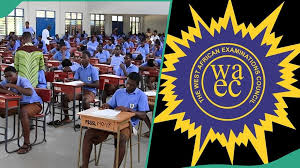
The West African Examinations Council (WAEC) Established in 1952, is an examination board established to conduct the examinations and to award certificates , in the English-speaking West African countries, (Ghana, Nigeria, Sierra Leone, Liberia and the Gambia) . WAEC previously published results of the 2025 WASSCE examinations on July 4 and announced that only 38.32 percent of its 1,969,313 candidates secured credits in five subjects, including English Language and Mathematics.
At a news conference in Lagos , WAEC said, after reviewing the process, the new statistics indicated that a total of 1,239,884 of the 1,969,313 candidates, representing 62.96 per cent, now have five credits, including English and Mathematics After reopening its online results portal on Friday, August 10, the pass rate was revised upward to 62.96 percent, effectively doubling the initial figure.
Stakeholders in the education sector criticises the West African Examinations Council (WAEC) over the sudden change in the recently released 2025 West African Senior School Certificate Examination (WASSCE) results.
The stakeholders, who spoke in separate interviews with the News Agency of Nigeria (NAN) in Abuja, are demanding independent investigations into the matter and an overhaul of the council’s management team. They contended that subjecting WASSCE, a standardised evaluation for secondary school leavers and a basic requirement for tertiary institution admissions, to “trial and error” is unacceptable.
According to them, inconsistencies in such high-stakes examinations could damage the credibility of Nigeria”s academic qualifications, both locally and internationally.
The mass failure had attracted strong criticism, with parents and some groups calling for the cancellation of some of the papers, especially English Language and Mathematics .
Subsequently, WAEC stated that it had discovered technical glitches during an internal review and temporarily suspended access to the results.
The Council linked the initial discrepancies to “serialisation issues” in subjects such as Mathematics, English, Biology, and Economics.
The Founder, Exam Ethics Marshall International (EEMI), Ike Onyechere, questioned the council’s credibility and the integrity of Nigeria’s education assessment system.
Onyechere described the development as “a national disaster,” accusing WAEC of “bastardising the entire education process.”
“You cannot make such a serious examination, a subject of trial and error. Today, the pass rate is 38 percent; tomorrow, it becomes 63 percent.
“How are we supposed to trust the authenticity of these results?,” he queried. Onyechere called on the Federal Ministry of Education, the Presidency, and the National Assembly to launch an urgent investigation into the matter, insisting that those at the helm of affairs in WAEC should be reshuffled.
“All the up and down with results, is it just in Nigeria or is it happening in Ghana, in Sierra Leone, in Gambia, all those West African countries?.
“And, if it is happening only in Nigeria, then, the Federal Ministry of Education has to tell the country what exactly is going on,” he said.
Onyechere dismissed the explanation WAEC gave on serialisation of papers as “technical excuses” that failed to address deeper administrative lapses.
“This is not a joke. We are gambling with the future of these students. Universities, employers, and foreign institutions rely on these results. “If people can no longer trust them, the consequences will be far-reaching.
” So, those people with the responsibility for leadership should step up and review the matter and carry out thorough investigations with dire consequences,” he said.
A teacher, Oluwaseun Omotubora, said that the mass failure recorded in the earlier results was a reflection of how the examinations were conducted.
Omotubora said one could not expect a better performance in the face of a systemic failure, which led to the writing of examinations at midnight and with the use of torchlight.
She said that, upon noticing the mass failure, a responsible examination body should have recalled the answer sheets of the affected subjects, reviewed them, and identified the problems before releasing the results. She said WAEC should have called for a fresh examination in the affected subjects, rather than creating the avenue for doubting the integrity of the body and the process.
A parent, Mrs Ifeoluwa Atteh, called for an independent investigation to determine whether candidates were unfairly failed or passed in either of the two results released.
Atteh urged caution, calling for a deeper analysis to ensure the results truly reflected improved learning outcomes, rather than just deliberate adjustments.
” The whole WAEC results is confusing. Does it mean that those results earlier released just changed now or what,” she questioned.
She called for thorough investigations to verify the authenticity of the newly released results.
