

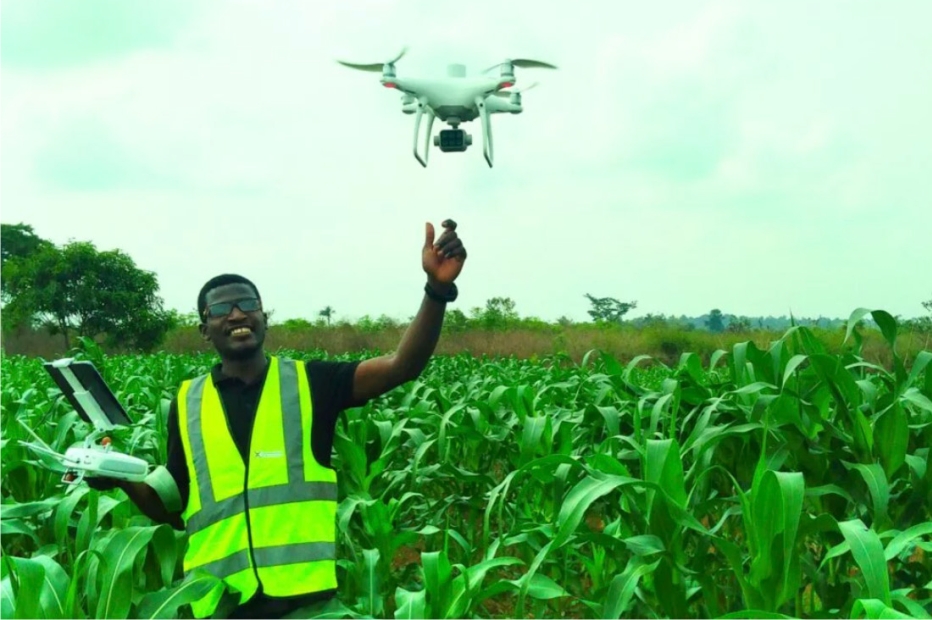
Nigeria, a nation of over 200 million people, faces mounting challenges from climate change, its economy; heavily reliant on agriculture is very affected by the recent unpredictability of climate, land degradation, and limited access to modern infrastructure. Agriculture accounts for approximately 20%
of Nigeria’s GDP and employs millions, from subsistence farmers to commercial growers. Yet, erratic rainfall, poor soil quality, and a lack of financing threaten the livelihoods of those who feed the nation. In response, a new wave of innovation is emerging, driven by a coalition of farmers, tech workers, and young entrepreneurs.

Artificial intelligence (AI), once used exclusively by urban tech hubs, is now finding its way into Nigeria’s fields, greenhouses, and poultry farms, heralding what some call “Agriculture 2.0.” This article explores how AI is transforming Nigerian agriculture, the challenges it faces, and the potential it holds for a sustainable future. Agriculture : The Backbone of Nigeria Nigeria’s agricultural sector is vast and diverse. From the plains of the Plateau State to the regions of the north, farmers cultivate crops like yams,
cassava, maize, and peppers, while others raiselivestock such as chickens and cattle. The central city
of Jos, located at 1,200 meters above sea level, is known for its mild climate and rich soils, making it a
hub for fruit and vegetable production. These goods feed local markets andsupply urban centers across the country.

However, the sector is under strain. Smallholder farmers, who make up the majority of Nigeria’s
agricultural workforce, often lack access to irrigation, modern tools, or reliable weather data. Climate change exacerbates these issues, with unpredictable rainfall and prolonged droughts driving some farmers away from their fields entirely. Poor harvests not only threaten food security but also destabilize rural economies. Many farmers, unable to sustain their livelihoods, abandon agriculture, contributing to urban migration and social unrest. Traditional farming methods, while resilient in the past, are
increasingly inadequate in the face of modern challenges. This is where AI enters the picture, offering tools to optimize resources, predict risks, and improve yields. In Nigeria, the adoption of AI is not driven
by multinational corporations, but by local innovators who understand the unique needs of their communities.
The Rise of Agri-Tech in Nigeria Startups like Green Eden and Anatsor, are leading the charge for Agri-tech in Nigeria, Nigerians, many still in their 20s, are developing AI-driven solutions tailored to the realities of local farming. Unlike global tech giants, which often prioritize large-scale commercial agriculture, these startups focus on smallholders and medium-sized farms, where the impact of technology can be immediate and impactful.
One of such innovators is Dandam Nangor, a 34-year-old IT analyst and farmer in Jos. His greenhouse,
equipped with soil probes connected to Green Eden’s AI platform, exemplifies the potential of this technology. The probes collect real-time data on soil pH, temperature, and moisture levels, which
the AI processes and sends to Nangor’s phone. This allows him to make precise decisions about when to water his pepper crops, or adjust greenhouse conditions. The result is a 20% increase in his yield, equivalent to an additional 400 kilograms of peppers. Nangor’s story is not an outlier but part of a
growing trend, as farmers across Plateau State adopt similar technologies to boost productivity.

Green Eden, founded by 21-year-old pharmacy student Stephanie Meltus, has deployed its AI technology on over 70 farms. The company’s flagship product, Scare Grow, uses AI to monitor
environmental conditions and provide actionable insights. For instance, farmers receive alerts about optimal planting times or warnings about potential pest infestations. Meltus, who started the company with financing from friends and family, sees her work as a bridge between Nigeria’s vibrant tech scene and its rural heartlands. Her vision is shared by other young entrepreneurs, who are leveraging Nigeria’s growing pool of tech talent to address agricultural challenges. AI in Action: From Crops to Poultry. The applications of AI in Nigerian agriculture are Anatsor’s systems
It is designed with Nigeria’s infrastructure limitations in mind. Only 40% of Nigerians have internet access, with connectivity rates dropping sharply in rural areas. To address this, Anatsor’s platform can
deliver alerts via SMS, ensuring that farmers without smartphones or reliable internet can still benefit. This focus on accessibility is a hallmark of Nigeria’s agri-tech movement, which prioritizes solutions that work within the constraints of local realities.
The Role of Tech Workers and Young Innovators. Nigeria’s tech sector, one of the fastest growing in Africa, is a key driver of this agricultural revolution. The country boasts a large community of software developers, data scientists, and IT professionals, many diverse, spanning crop farming, poultry, and market analysis. In crop production, AI tools like those developed by Green Eden help farmers optimize resource use.
By analyzing data from soil sensors and weather forecasts, these tools recommend precise irrigation schedules, reducing water waste in a region where drought is a constant threat. They also monitor
soil health, alerting farmers to nutrient deficiencies before they impact yields. For smallholders, who often operate on razor-thin margins, these incremental improvements can mean the difference
between profit and loss.
In poultry farming, AI is proving equally useful. Mercy Atsuku, a chicken farmer in Jos, uses a monitoring system developed by Anatsor, a local startup founded by 24-year-old Miriam Agbo. The system
tracks temperature, humidity, air quality, and water quality in real time, sending alerts to Atsuku’s phone when conditions deviate from optimal levels. This is critical in a region where climate change has
made weather patterns unpredictable.
High temperatures can cause chickens to stop eating, while excessive humidity can lead to damp conditions that increase mortality rates. Since adopting Anatsor’s technology, Atsuku reports “barely any mortality cases,” a stark of whom are turning their skills toward agriculture. This convergence of tech and farming is creating new opportunities for collaboration. For example, Dandam Nangor, with his dual expertise as an IT analyst and farmer, embodies this hybrid identity. His ability to navigate both worlds allows him to implement AI solutions effectively and advocate for their adoption among other farmers.
Young innovators are also playing a pivotal role. Gambo Wadams Zakka, an English literature student, is developing a startup that combines satellite imagery an AI to monitor pest infestations. His platform
would send SMS alerts to farmers, warning them of potential threats and suggesting mitigation strategies. Zakka’s vision extends beyond pest control; he aims to provide market price updates, helping farmers decide when to sell their crops for maximum profit. For instance, an alert might inform a farmer
that a bag of beans is selling for 15,000 naira but is expected to rise the following week. Such information empowers farmers to make informed decisions, reducing the guesswork that often leads
to financial losses.
Zakka’s startup, like many others, began with modest funding from friends and family. As it gained
traction, businesses and foundations stepped in, recognizing the potential to bridge Nigeria’s urban
tech ecosystem with its rural agricultural base. This influx of investment is fostering a virtuous cycle,
where innovation attracts funding, which in turn fuels further innovation. The result is a dynamic agritech ecosystem centered in Jos, but with the potential to scale nationwide. Despite its promise, AI
in Nigerian agriculture faces significant problems.
One major challenge is infrastructure. Poor roads, unreliable electricity, and limited internet access hamper the deployment of AI technologies, particularly in remote areas. While SMS-based solutions like Anatsor’s help to reduce the connectivity issue, they are not a complete fix. Another challenge is financing. Many smallholder farmers lack the capital to invest in AI tools, even those designed to be affordable.
Green Eden and Anatsor have kept costs low by focusing on subscription-based models, but upfront expenses for sensors or smartphones can still be prohibitive. Access to credit is also a barrier, as banks are often reluctant to lend to small-scale farmers due to perceived risks. Without addressing these financial constraints, the benefits of AI may remain out of reach for the majority of Nigeria’s farmers.
Another point to properly evaluate the situation is that AI, while powerful, does not address all of agriculture’s problems. Land degradation, caused by years of intensive farming and erosion, limits the effectiveness of even the most advanced technologies.
Similarly, AI cannot compensate for systemic issues, like poor market access or exploitative middlemen who drive down farmers’ profits. Some argue that the focus on AI-driven productivity gains distracts from the need to mitigate agriculture’s environmental impact. For instance, increasing yields
through intensive farming could exacerbate soil depletion if not paired with sustainable practices. There is also the question of trust. Farmers, many of whom have relied on traditional methods for generations, may be skeptical of AI’s benefits. Building trust requires not only demonstrating tangible results but
also ensuring that technologies are userfriendly and culturally relevant. Startups like Green Eden and Anatsor are addressing this by involving farmers in the design process, ensuring that solutions align with local needs and practices.
The integration of AI into Nigerian agriculture has implications beyond the farm. By increasing yields and reducing losses, AI can enhance food security, a pressing concern in a country where hunger
remains a challenge. It can also stabilize rural economies, discouraging migration to overcrowded urban centers. For Nigeria’s youth, many of whom are drawn to tech careers, agri-tech offers a chance to apply
their skills in a sector with deep cultural and economic significance.
Moreover, the rise of agri-tech hubs like Jos, could position Nigeria as a leader in African innovation. The continent, with its young population and vast agricultural potential, is ripe for similar transformations. Nigeria’s experience could serve as a model, demonstrating how local ingenuity can address global challenges like climate change and food insecurity. However, this will require sustained investment, supportive policies, and collaboration between government, private sector, and civil
society.
The environmental implications are equally significant. While critics warn of AI’s potential to prioritize output over sustainability, there is also an opportunity to use AI for regenerative agriculture. For example, AI could guide farmers in crop rotation, cover cropping, or agroforestry, practices that restore soil health and sequester carbon. Green Eden and other startups are beginning to explore these possibilities, recognizing that long-term productivity depends on environmental stewardship.
Looking Ahead: The Future of Agriculture 2.0
The vision of Agriculture 2.0 in Nigeria, is ambitious but achievable. It envisions a future where farmers, armed with AI tools, can adapt to climate change, maximize yields, and thrive in a competitive market. It sees tech workers and young innovators as partners in this transformation, bringing fresh perspectives and technical expertise. It imagines a Nigeria where rural communities are empowered, food is
abundant, and agriculture is a source of pride and prosperity. Achieving this vision will require overcoming significant obstacles. Infrastructure must improve, financing must become more accessible, and policies must support innovation while protecting farmers’ interests. Education and training will also be critical, ensuring that farmers and tech workers alike have the skills to navigate an AI-driven future.
In conclusion, AI could play a significant role in agriculture in future years, but systems have to be put in place for proper functioning. Partnerships between startups, universities, and international organizations could accelerate this process, fostering knowledge exchange and capacity building.
Economic significance.
Moreover, the rise of agri-tech hubs like Jos, could position Nigeria as a leader in African innovation. The continent, with its young population and vast agricultural potential, is ripe for similar transformations. Nigeria’s experience could serve as a model, demonstrating how local ingenuity can address global challenges like climate change and food insecurity. However, this will require sustained investment, supportive policies, and collaboration between government, private sector, and civil
society.
The environmental implications are equally significant. While critics warn of AI’s potential to prioritize output over sustainability, there is also an opportunity to use AI for regenerative agriculture. For example, AI could guide farmers in crop rotation, cover cropping, or agroforestry, practices that restore soil health and sequester carbon. Green Eden and other startups are beginning to explore these possibilities, recognizing that long-term productivity depends on environmental stewardship.
Looking Ahead: The Future of Agriculture 2.0
The vision of Agriculture 2.0 in Nigeria, is ambitious but achievable. It envisions a future where farmers, armed with AI tools, can adapt to climate change, maximize yields, and thrive in a competitive
market. It sees tech workers and young innovators as partners in this transformation, bringing fresh perspectives and technical expertise. It imagines a Nigeria where rural communities are empowered, food is abundant, and agriculture is a source of pride and prosperity. Achieving this vision will require overcoming significant obstacles. Infrastructure must improve, financing must become more accessible, and policies must support innovation while protecting farmers’ interests. Education and training will also be critical, ensuring that farmers and tech workers alike have the skills to navigate an AI-driven future.
In conclusion, AI could play a significant role in agriculture in future years, but systems have to be put in place for proper functioning. Partnerships between startups, universities, and international
organizations could accelerate this process, fostering knowledge exchange and capacity building.
